
|
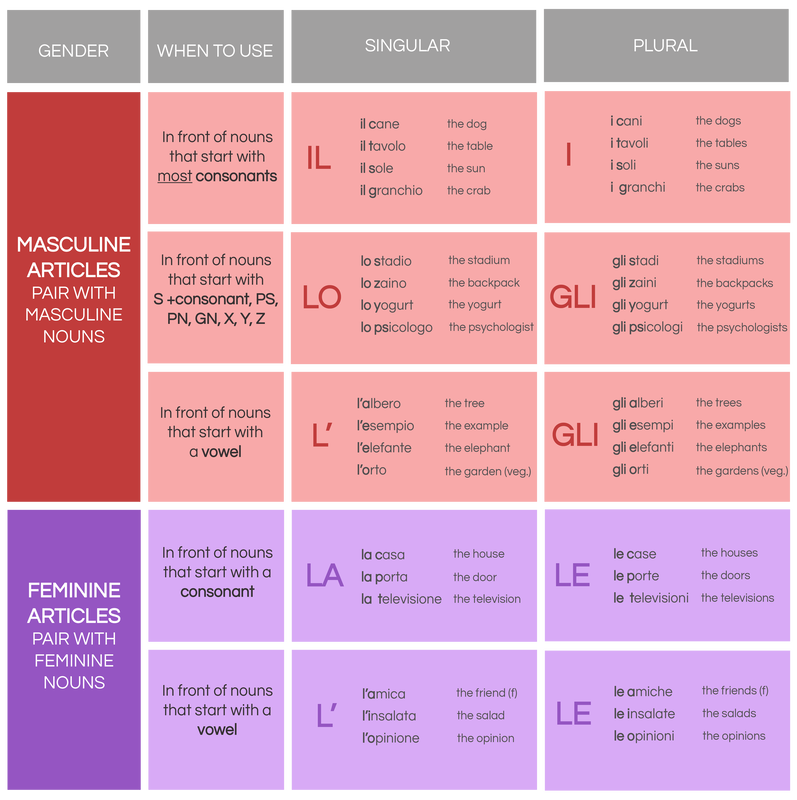
In Italian, definite articles are words that take the meaning "THE", when paired with a noun. Articles don't really have a meaning on their own; they must always accompany an appropriate noun.
Definite articles must agree with nouns in number and gender, and they always come before the noun. Examples:
In the above examples, the articles le and il refer to a definite object (keys) and a definite person (math professor). Because definite articles must agree with nouns in number and gender, they have masculine, feminine, singular, and plural forms. |
|
DEFINITE ARTICLES ARE USED...
DEFINITE ARTICLES ARE NOT USED...
ESERCIZI/EXERCISES Add the article to the following nouns, then make them plural along with their articles: Review Gender of Nouns and Plural Nouns, if necessary. >> double click or highlight the spaces to reveal the answers! << singular plural 1. _la_ cipolla > ___le_cipolle____ 2. _l'__ orologio > ___gli_orologi___ 3. _lo_ spazzolino > __gli_spazzolini__ 4. _l'__ aula > ___le_aule____ 5. _l'__ albero > ___gli_alberi____ 6. _la_ televisione > __le_televisioni__ 7. _l'__ attrice > ___le_attrici____ 8. _la_ città > ___le_città____ 9. _la_ chiave > ___le_chiavi____ 10. _il_ giornale > ___i_giornali____ 11. _la_ gamba > ___le_gambe____ |